
Twin City 12-20
Verified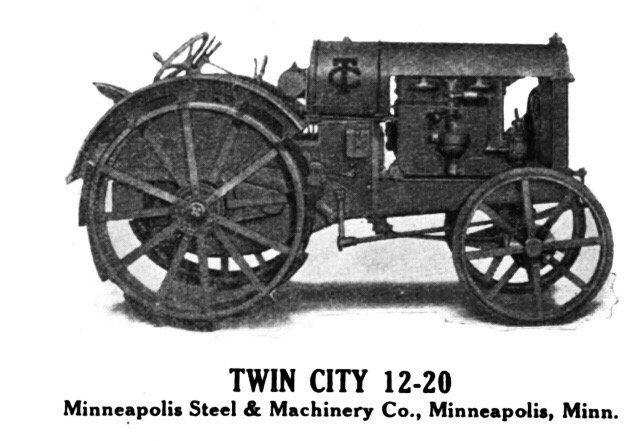
The Twin City 12-20 was Minneapolis Steel & Machinery’s most popular Twin City tractor and an engineering standout — built 1918–1926 by one of Minneapolis-Moline’s predecessor companies.
Identification & configuration
Per the compiled Twin City record, the 12-20 used a notable twin-cam, 16-valve four-cylinder engine (4¼ × 6 bore/stroke, ~340 cubic inches), and about 9,000 were built — making it the most common Twin City model.
It is a direct MM predecessor; see the Twin City tractors overview and how the predecessors merged into MM.
Factory paint
Per the MMCI paint records, Twin City tractors of this era (including the 12-20) were Battleship Gray overall, with red lettering on the top radiator tank. See the full paint reference.
What to verify
- Serial: the 12-20 ran serials 10201–19219; decode yours (ranges below).
- Engine: confirm the 16-valve twin-cam four — a defining feature of the model.
Sources & Verification Notes
Engine spec, production figure, and serials per Tony Thompson’s compiled Twin City record (hosted by MMCI); paint per the MMCI Paint Committee. We do not assert horsepower figures, and we flag production counts as collector-reported until confirmed against factory literature.
Serial Number Ranges
| Year | Serial range | Number type | Source confidence |
|---|---|---|---|
| — | 10201 – 19219 | tractor plate | Verified High |
| 1925 | 20001 – 20012 | tractor plate | Verified High |
Specifications
| Nebraska Test | No. 19 (1920) |
|---|---|
| Manufacturer | Minneapolis Steel & Machinery Co., Minneapolis, Minn. |
| Brake HP (rated) | 20.32 hp @ 1009 rpm |
| Brake HP (max) | 21.93 hp @ 1011 rpm |
| Drawbar HP (rated) | 13.86 hp @ 1772 lb pull |
| Drawbar HP (max) | 18.43 hp @ 3476 lb pull |
| Engine | 4-cylinder vertical, valve-in-head (16-valve) |
| Bore x Stroke | 4 1/4" x 6" |
| Rated RPM | 1000 |
| Magneto | Bosch DU4 |
| Carburetor | Holley |
| Fuel | Kerosene |
| Total Weight | 5000 lb |
| Speeds | Low 2.2 mph, High 2.93 mph |
| Tested fuel economy | 7.88 hp·hr/gal |
| Test remark | Valve tappets were adjusted once and the copper tube fuel line was cut off 1/2 inch to repair a leak. |
Specifications per the cited source below. Manufacturer-advertised figures can differ from tested values — confirm restoration-critical specs against factory literature.
Source: Nebraska Tractor Test No. 019 (1920) — Twin City 12-20
Factory Paint Colors
Body, wheel, and powertrain colors documented for this model's era by the MMCI Paint Committee. The exact part-by-part configuration, year breaks, and footnotes are in the full paint reference. Individual tractors vary — special orders and regional exceptions were common, so confirm against your own machine.
- Battleship Gray (body)
Finding Parts
We don't publish part numbers we can't verify against factory literature. The authority for this model's part numbers is its factory parts catalog; interchange is serial- and configuration-dependent, so always confirm against the parts book before buying.
Surviving Examples (collector-reported census)
Owner-submitted survivors, reviewed before publishing. Collector-reported — these corroborate, but do not establish, the documented serial ranges above.
- 1 known survivor
- Serials observed: 10,202–10,202
- 9,700 built (per Production total source — Twin City 12-20)
- Observed survival rate so far: 0.01% (1 registered of 9,700 built — grows as more are logged)
Add your Twin City 12-20 to the registry → Browse the full census →
Sources & Verification Notes
Status: Verified
Primary source: Twin City Tractor Serial Numbers — Tony Thompson (MMCI) tier 2
Last checked: 2026-05-31
Where this model fits in the Minneapolis-Moline history & timeline →
Videos

Curated third-party videos — MinnieMo is not affiliated; links open on YouTube.
Owner Notes & Questions
Own one, restored one, or have a question about this model? Share it below. Notes are moderated before they appear, and owner-reported details are not treated as verified facts until cited.
Add a note or question